When Water Flows, So Do Opportunities: Empowering Women
Have you ever thought about how much of your day is defined by the simple act of getting a glass of water? For most of us, it’s a few seconds – a turn of the tap.
But what if it took five hours? What if that single task defined your entire day, every day?
For millions of women across rural India, this isn’t a hypothetical question. It’s a back-breaking reality. It’s a journey that steals time, drains health, and dims futures, with the heaviest burden falling on women and girls. At Project Chirag, we’ve seen how one simple change—bringing water closer to home—can start a ripple effect of change. Because when water flows freely, so do opportunities.
The True Cost Of A Single Pot Of Water: A Burden Borne By Women
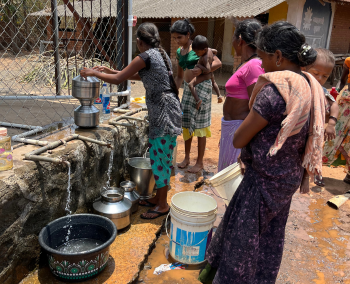
Think about it: four, sometimes five, hours spent walking to a distant well or pond. Every single day. Their bodies ache under the constant strain of carrying heavy water pots. They worry constantly about the contaminated water making their children sick. The impact of clean water on women’s lives goes far beyond just hydration; its absence creates a cycle of hardship.
The heaviest price they pay, however, is in lost potential.
Those are hours a young girl isn’t sitting in a classroom, learning to read and write. There are hours a mother isn’t able to earn an income for her family. This is not just a daily chore; it’s a thief of dreams, holding women back and keeping their families trapped in poverty.
A New Story Begins To Flow: Impact Of Clean Water On Women’s Lives in Waghatpada
But this story doesn’t have to end there. This is where we see hope turn into action. Consider the women of Waghatpada Village, living a tragic reality just 2.5 hours from the bustling city of Mumbai.
The Problem: A Life Without Water or Dignity
Here, the lack of water had catastrophic consequences. Women walked long distances not only for drinking water, which they often had to get by digging holes in a riverbed and waiting hours for it to filter, but also for basic sanitation. They were forced to defecate in the open, a daily risk to their safety and dignity. The few toilet cubicles that existed were non-functional, rendered useless by the very absence of water. This wasn’t just an inconvenience; it was a crisis that fueled waterborne diseases and stole their quality of life.
The Solution: Project Chirag’s Collaborative Model
Our Integrated Village Development Program was designed to rewrite this story. We didn’t just provide a resource; we fostered community ownership. Project Chirag brought a main water line to the village. Then, in an inspiring display of collective action, the villagers themselves conducted ‘shramdaan’ (voluntary labor), toiling to build their own tertiary pipelines. They created their very own “Har ghar nal” (tap in every home) system.
This single change had a massive ripple effect:
- Running water activated their toilets.
- Community toilets were built for those without household units, ensuring safe sanitation for all.
- Water filters in each home ensured that they were no longer drinking turbid, unsafe water.
The outcome is palpable. By making 44,130 litres of clean water available every day, through our clean water program, we are directly combating malnutrition and the diseases that plague the hinterlands.
From Carrying Water To Leading Change: Women's Empowerment Through Water Access
So, what happens when a woman gets back five hours in her day?
Everything.
She doesn’t just gain time; she gains a voice. She is no longer just a water bearer; she becomes an agent of change. We see girls enrolling in school, their attendance no longer tied to the long walk for water. We see women joining Self-Help Groups, the hum of sewing machines replacing the silence of an empty afternoon. They learn new skills, start small businesses, and for the first time, contribute to their family’s income with a pride that is truly transformative.
This is what improving women’s opportunities with water truly looks like. It’s in the confident voices of women now participating in village meetings, making decisions for their community’s future. The principle of access to water empowering rural women comes to life in these moments.
“I am 14 years old. My mother works on the farm the whole day. I have to look after my siblings, feed them on time, as well as complete home chores. A lot of my time was spent walking kilometres just to get two handas of water because of which I had to miss school. I was not able to study in the evenings because of no light. But now water is at our doorstep, I can study and complete my house chores with ease”. – RUPALI DHAMALE. Sawade, Palghar.
You Can Be Part Of This Story: Lead The Story With Project Chirag
Water is more than just water. It’s time. It’s health. It’s dignity. It is the key that unlocks the door to education, income, and leadership.
You can help us turn that key. Your support for Project Chirag’s work helps turn on a tap, and in doing so, you help unlock a woman’s potential and a community’s future.
Donate to solar power NGO today to help us create more stories of empowerment, one village at a time.