We Talk About Smart Cities, But What About the Dark Villages?
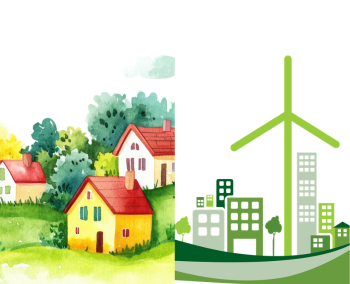
India loves to talk about the future, AI-enabled transport, smart grids, ultramodern business districts, urban hubs that promise efficiency and convenience at every turn. But step outside these islands of progress, and the contrast hits hard. While cities race toward “smartness,” thousands of rural communities still end their day by sunset because there is no reliable power to carry them forward.
This is the paradox that rarely gets discussed: Smart cities vs rural villages is not just a comparison of two geographies. It is the story of two Indias developing at two very different speeds.
And unless we bridge this gap, true inclusive development in India will remain out of reach.
The Hidden Reality Behind India’s Growth Story
On paper, India has made remarkable progress in electrification. Government schemes have expanded power lines to remote corners. Yet, talk to families, teachers, or small entrepreneurs in these villages and a different picture emerges.
Many rural communities still experience:
- Poor grid reliability
- Voltage fluctuations
- Night-time blackouts
- Zero backup alternatives
- Unsafe or polluting lighting solutions, like kerosene lamps
These are India’s dark villages, not because they lack ambition, but because they lack the energy infrastructure to support that ambition.
When a home loses light, a child loses study hours.
When a clinic loses power, a patient loses safety.
When a village goes dark, an entire economy slows down.
The gap is more than symbolic; it is deeply structural.
The Urban-Rural Infrastructure Gap: A Growing Divide
A smart city is built on strong systems, transport, electricity, digital networks, emergency response, waste management. Each layer is supported by predictable power.
But in many rural regions, the basic expectation of “switch on the light and it will work” is still not guaranteed.
This urban rural infrastructure gap is no longer just an issue of convenience. It shapes everything from migration patterns to educational outcomes to long-term economic stability.
- Cities continue attracting talent because they offer reliable power and digital access.
- Villages struggle to retain youth because growth seems impossible without infrastructure.
- Local businesses cannot scale because production depends on energy.
- Farmers cannot adopt modern tools because machines need electricity.
The result? Two parallel Indias, one accelerating, one waiting.
If our development is to be meaningful, both need to move forward together.
Energy Inequality in India: The Real Barrier to Progress
We talk about income inequality all the time. But energy inequality in India is just as significant.
Imagine a city home that has uninterrupted electricity, Wi-Fi, smart home devices, and power backup. Now compare it to a village household where phones are charged once every two days, where dinner must be cooked and eaten before dusk, and where children finish homework using dim light from a kerosene lamp.
Energy is not just an amenity, it defines opportunity.
When power becomes a privilege instead of a basic right, everything else becomes harder:
- Learning
- Earning
- Healthcare
- Safety
- Mobility
- Digital access
And that, in turn, affects the next generation.
This is why rural electrification is not just an infrastructure project. It is a social transformation initiative.
The Smart Village Concept: A Missing Piece in India’s Vision
India has a strong narrative around smart cities. But building a smart country requires us to think equally about the smart villages concept in India.
A smart village doesn’t need skyscrapers or hyperloop trains. It needs:
- Reliable, clean, non-polluting energy
- Digital access so children and youth can learn, upskill, and create
- Safe lighting in homes, schools, and community spaces
- Energy solutions that survive weather, geography, and grid limitations
- Tools for entrepreneurs to build local economies instead of leaving for cities
Solar energy becomes a natural fit here. It’s sustainable, low-maintenance, and resilient. And it gives families a sense of control, they are no longer waiting for grids to behave.
When villages get clean energy, the transformation is immediate and visible:
- Students study longer hours
- Shops stay open past sunset
- Women feel safer walking outdoors
- Healthcare workers can serve better
- Farmers store produce longer
- Youth stay back to build local businesses
Smart cities may symbolize progress, but smart villages sustain it.
Rural Electrification in India: Why It Needs Continued Attention
Yes, India has electrified most villages officially. But the challenge now is ensuring quality, reliability, and sustainability.
The real measure of progress is not “Is there a pole?”
It is “Does the light actually turn on when needed?”
This is where organisations like Project Chirag step in. Instead of waiting for large grid infrastructure to catch up, clean energy solutions offer immediate access to light, safety, and dignity.
Solar power projects become the core of transformation brought about. Solar-powered home lighting, school lighting, study lamps, and community systems become powerful levellers. They remove energy poverty and create a fairer starting line.
And this is crucial for the next decade. Because India cannot talk about innovation, digitisation, and economic leadership while millions experience darkness every night.
Lighting Villages Is Nation Building
For too long, rural development has been seen as an optional chapter. But every urban success story relies on rural India, its food, its workforce, its culture, its natural resources.
If villages lag behind, cities cannot sustain their momentum.
Investing in rural electrification is not philanthropy. It is strategic, long-term nation building. It strengthens education, improves health, boosts local economies, and protects the environment.
Most importantly, it closes the distance between two Indias.
And light, clean, dependable, and accessible, is the first step toward that transformation.
The Path Forward
India’s future cannot be written in the glow of cities alone. It must shine equally in every village that is currently waiting for opportunity to arrive.
Smart cities are important, they show what is possible.
But smart villages? They show what is necessary.
When we light a village, we don’t just fix infrastructure.
We unlock potential.
We protect dignity.
We brighten futures.
And we build the kind of India that grows together, not in fragments, but in unity.
Support Rural Development for a better tomorrow.