The Generational Impact of School Electrification in India
In many rural parts of India, the learning day ends not when the bell rings, but when the sun sets. Imagine a classroom where, as twilight deepens, children must stop reading and writing, their potential literally dimmed by darkness and a lack of power. This challenge restricts study hours and blocks access to the modern tools necessary for real growth.
This is the gap that Project Chirag was born to bridge. Our mission, led by India’s dynamic youth, is simple yet profound: to provide solar lighting to India’s rural poor. But when we talk about school electrification India, we aren’t just installing lights; we are fueling a foundational intervention that ignites generational change, creating a pathway for a genuine and lasting Integrated School Development program.
The Immediate Shift - Brightening Solar-Powered Classrooms
The most immediate change is the most powerful. When a school is successfully electrified, the clock suddenly gains valuable hours.
For students, this means they can study after sunset, dramatically increasing their effective learning time. This is the simplest, most fundamental benefit of reliable electricity access in schools. For teachers, improved visibility means better lesson planning, more focused evaluations, and higher-quality instruction.
Beyond academics, there’s a critical Safety and Health Dividend. Replacing hazardous kerosene lamps with clean, efficient solar lighting eliminates indoor air pollution and the constant risk of fire. This shift immediately creates a safer, healthier, and more supportive environment for everyone inside the solar-powered classrooms.
The Generational Leap - Unlocking Digital Learning in Rural India
While extending the school day is transformative, the true long-term impact of electrification is its ability to future-proof education. A reliable power source transforms the school into a primary gateway to the modern world.
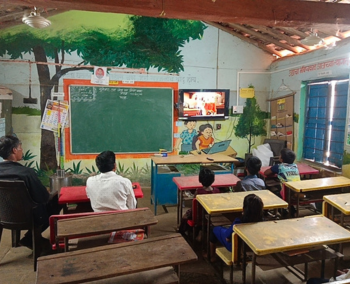
Electrification is the non-negotiable prerequisite for using computers, projectors, and digital educational content. This enables digital learning in rural India, exposing children to resources and curricula previously unavailable to them. This Generational Impact is key: equipping the current cohort with essential 21st-century skills breaks the intergenerational cycle where a lack of resources limits future economic potential.
Furthermore, the newly electrified school often becomes the first Community Electrification node. This hub offers a reliable place for villagers to charge essential devices or gather for community meetings, radiating development outward from the educational core.
Project Chirag’s Framework for Sustainable Education Infrastructure
The longevity of our impact is rooted in how we work. Project Chirag believes a project is only as strong as the community that sustains it. This is why our framework, which sees youth, donors, partners, and beneficiaries as equal stakeholders, is essential for building sustainable education infrastructure.
Our commitment starts long before installation:
- Needs and Feasibility: We conduct detailed primary studies to Identify Requirements, ensuring the intervention is context-driven. We follow this with a Technical and Field Assessment to guarantee the solution is environmentally sound and practical for the terrain.
- Community Ownership: A unique feature of our work involves the villagers contributing effort (shramdaan) and sometimes land (bhoodan). This ensures deep local buy-in. When a community invests its own labor, the project’s future is secured.
- Education and Empowerment: The intervention is complete only when we train the villagers on its purpose and use. This Community Education phase secures the long-term success of our energy for education initiatives, empowering them to nurture their newfound development long after our initial team departs.
Monitoring and Lasting Change
True sustainability isn’t just about using a renewable resource; it’s about a village being able to sustain the intervention after the implementing organization exits.
Project Chirag is dedicated to this outcome. We invest in forming local committees and providing training on the high-quality equipment supplied. We follow this up with rigorous Monitoring & Evaluation. A commitment to learning from what works and what doesn’t. Our on-ground partners ensure their “thumb is on the pulse” of the project, monitoring it during and after implementation.
The final result is measured through Impact Assessment, providing clear, objective data on the quantifiable and qualitative benefits achieved, proving the long-term success of the project.
Lighting the Future With Project Chirag
School electrification India is more than a utility upgrade; it is an investment in human capital that yields powerful, generational returns. By using solar power projects, we offer a clean, reliable, and decentralized solution that transforms education, health, and economic prospects in rural communities.
Every light switch turned on in a solar-powered classroom is a step towards self-sufficiency and empowerment for an entire village. We invite you to partner with Project Chirag in this critical work, allowing more young lives to be illuminated and accelerating rural education development across India.