Solar Energy and Women Empowerment in Rural India
How Solar Energy Is Quietly Closing the Gender Gap in Rural India
In thousands of villages across India, the biggest barrier to a woman’s day was never ambition. It was light, water, and time. Solar energy and women empowerment are now showing up together in research and on the ground, and the connection is not incidental.
Why Energy Access Has Always Been a Women's Issue
Domestic energy use in rural India has historically fallen on women: collecting fuel, fetching water, cooking over smoke-heavy stoves. When electricity is unreliable or absent, women absorb the cost in time and health. Energy access and gender equality are linked because the burden of energy poverty was never distributed equally to begin with.
India has installed over 700,000 solar-powered water pumps in recent years, reducing the need for women to walk long distances for water and lowering their exposure to harassment along the way (The Fuller Project, 2024). Solar lighting has also displaced kerosene lanterns and candles, whose fumes disproportionately affect women and children because they spend more hours indoors (The Fuller Project, 2024).
Solar-Powered Livelihoods Are Changing Household Roles
A multi-state solar lamp initiative across Assam, Bihar, Jharkhand, and Uttar Pradesh trained rural women to assemble, sell, and repair solar lamps, then supported them in starting their own energy enterprises. A study tracking 313 women involved in the program found measurable gains in decision-making power, financial control, and household and community standing among the women who ran these enterprises (Standal et al., 2023). This is what solar-powered livelihoods look like in practice: not a side benefit, but a direct shift in who holds economic leverage at home.
A separate field study in West Bengal’s Bankura district examined whether installing micro solar domes in two blocks, Hirbandh and Ranibandh, could enable income-generating activity for women and contribute to their socio-economic standing (ScienceDirect, 2024). The pattern across these regions is consistent: where solar infrastructure reaches a household, women are more likely to find a foothold in paid or semi-paid work.
Rural Women Development in India Needs More Than Wiring
Rural women development India efforts often stop at infrastructure. But research from tribal communities in rural India shows that electrification’s effect on gendered roles is not automatic or immediate; it requires social adaptation over time, and a few studies have established a clear causal link between electricity access and shifts in women’s roles (Standal & Winther, 2016, as cited in recent tribal electrification research). In other words, solar panels alone do not rewrite social norms. Training, enterprise support, and community involvement are what convert access into agency.
This is also why gender equality in rural India cannot be treated as a side effect of energy projects. It needs to be a stated goal, built into how solar-based livelihood solutions India are designed, who is trained, and who is allowed to lead.
Clean Energy for Women: What Actually Works?
The clearest gains documented so far share three features:
- Skills-based training, not just product distribution
- Enterprise ownership, where women sell and repair solar equipment rather than only use it
- Community-anchored work, allowing women to earn locally instead of migrating, something social norms in many villages still restrict (The Fuller Project, 2024)
Clean energy for women works best when it is paired with a route to income, not just a switch that turns on.
Sustainable Rural Development Depends on Women's Participation
India remains a largely rural country, with more than two-thirds of its population living outside cities (World Bank data, as cited in The Fuller Project, 2024). Any serious push toward sustainable rural development has to include the women who run rural households and, increasingly, rural micro-enterprises. Women empowerment through renewable energy is not a separate track from rural development; in villages where solar reaches both the home and the workplace, it is the same track.
The Work Still Ahead
The research is honest about its limits. Sample sizes in several of these studies are modest, and most researchers caution against assuming solar access guarantees empowerment on its own. What the evidence does show is a consistent direction: where solar energy is paired with training and ownership, women gain more control over their time, their income, and their decisions.
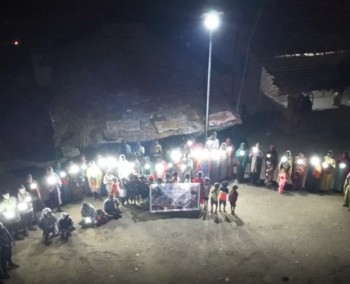
That is the gap Project Chirag works in every day, bringing solar power to villages that still wait for the grid, and building the support systems around it so that light becomes more than convenience.
Help bring solar power and real opportunity to a village that needs it. Donate For Rural Development India.
FAQs
- How does solar energy help empower women in rural areas?
Solar energy reduces the time women spend fetching water and fuel, cuts exposure to toxic kerosene fumes, and opens income opportunities through solar-powered livelihoods like selling or repairing solar equipment. - What is the link between clean energy and gender equality?
Energy access and gender equality are linked because women traditionally bear the time and health costs of energy poverty. Reliable solar power shifts that burden and frees up time for paid work or education. - Can solar power create jobs for rural women in India?
Yes. Multi-state solar lamp initiatives in Assam, Bihar, Jharkhand, and Uttar Pradesh have trained women to assemble, sell, and repair solar lamps, leading to measurable gains in their financial control and household decision-making (Standal et al., 2023). - Does electricity access alone improve women’s status in villages?
Not automatically. Research on tribal communities in rural India shows that social adaptation, not electrification alone, drives change in gendered roles. Training and enterprise support are what make the difference. - How is Project Chirag involved in solar energy and women empowerment?
Project Chirag brings solar electrification to villages still without reliable power, pairing it with broader rural development work so that access translates into real opportunity for women and families.
References
ScienceDirect. (2024). Renewable energy for women empowerment: Experiences from rural West Bengal. https://www.sciencedirect.com/science/article/abs/pii/S1364032124001692
Standal, K., et al. (2023). Can community based solar energy initiatives deliver on women’s empowerment in India? Evidence from rural Assam, Bihar, Jharkhand and Uttar Pradesh. ScienceDirect. https://www.sciencedirect.com/science/article/abs/pii/S2214629623002852
Standal, K., & Winther, T. (2016, as cited in 2026 tribal electrification study). ‘Now we feel completely lazy’: Social and cultural dimensions of solar electrification among tribal women in rural India. Taylor & Francis Online. https://www.tandfonline.com/doi/full/10.1080/0966369X.2026.2645561
The Fuller Project. (2024). India’s solar power push delivers an unexpected bonus – empowering rural women. https://fullerproject.org/story/indias-solar-power-push-delivers-an-unexpected-bonus-empowering-rural-women/