Rural Development Is Not a Sector-It’s an Ecosystem
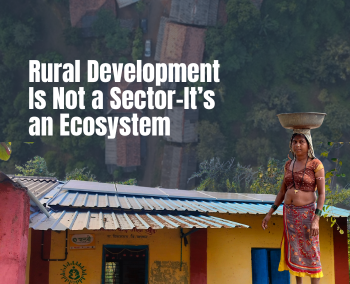
Rural development doesn’t improve lives through one “sector” at a time. It works only when education, health, livelihoods, water, sanitation, energy, and infrastructure move forward together. That is why rural progress must be planned like an ecosystem, where every change supports (or blocks) another.
For this reason, any sustainable development NGO working in rural India must look beyond isolated interventions and focus on how daily village systems function together.
Why “Sector-Wise Development” Often Fails In Villages
Many rural initiatives fail not because the work is bad, but because it’s incomplete.
For example:
- A school building is created, but children still don’t attend because of health issues, poor nutrition, or lack of transport.
- A skill program is launched, but jobs don’t sustain due to a lack of power, market access, or migration pressure.
- A water project succeeds, but women still lose time daily because sanitation and household infrastructure weren’t included.
This is exactly what experts call multi-sector rural development, where problems are linked, and solutions must be linked too. Sustainable rural development requires investments in rural infrastructure + health + education + livelihoods, not in isolation.
The Rural Development Ecosystem: Everything Is Connected
Think of a village like a living system. When one part is weak, the whole system struggles.
1) Livelihoods + Education
Education increases earning capacity, but only if families can afford to keep children in school.
When incomes are unstable, children often drop out to support household work or seasonal labour.
So improving livelihoods, education, and healthcare in rural areas together becomes essential, not optional.
2) Health + Attendance + Productivity
When households have recurring illness, poor nutrition, or low access to primary healthcare:
- Students miss school
- Adults miss work
- Savings get wiped out in medical expenses
This is why holistic rural development always includes preventive healthcare, hygiene, and community awareness, not only hospitals.
3) Infrastructure + Income
Livelihoods depend on systems like:
- Electricity
- Roads
- Clean water
- Storage and local connectivity
No matter how good a training program is, income can’t scale without basic infrastructure. Rural development is “blocked” when infrastructure is missing.
4) Water, sanitation, and women’s time
In many villages, women’s daily routines are shaped by access to water and sanitation.
Improving water + sanitation + energy access directly improves:
- Women’s health
- Children’s school regularity
- Household productivity
This is why community-centered rural development must treat women’s time as a core development metric, not a “social benefit.”
What “Interconnected Rural Development” Looks Like On The Ground
An ecosystem model doesn’t mean doing everything everywhere. It means planning smart links.
A practical ecosystem approach follows this sequence:
- Start with basic enablers (energy + water + sanitation)
- Strengthen education systems (school support + learning continuity)
- Build health resilience (prevention + access)
- Enable livelihood upgrades (skills + market linkage + local enterprise)
- Anchor everything in community ownership
This is how sustainable rural development models scale without collapsing after one funding cycle.
How Project Chirag Fits Into This Ecosystem Approach
Project Chirag is built on a simple but powerful idea: villages become self-sufficient when development is integrated, not fragmented.
Instead of treating energy as a standalone intervention, Project Chirag’s work connects core rural needs: homes with light, water, food, education, sanitation, and livelihoods, into one sustainable pathway.
This is exactly what the ecosystem approach demands: development that supports daily life, not just “projects”.
A simple truth: rural transformation is a chain reaction
If we want lasting impact, we must stop asking:
“Which sector are we working in?”
And start asking:
“Which ecosystem are we strengthening?”
Because rural development is not a list of activities.
It is a connected system, and when we improve one part responsibly, the whole village moves forward.
If you want to be part of this change, you can support rural development by contributing to Project Chirag’s community-focused initiatives.