Earth Day Is Every Day When You Live Off-Grid: Rural India's Accidental Environmentalists
Every April 22, cities hold marches, companies publish pledges, and social feeds fill with infographics about reducing, reusing, and recycling. The conversation is almost always the same: it is directed at people who have the option to choose differently.
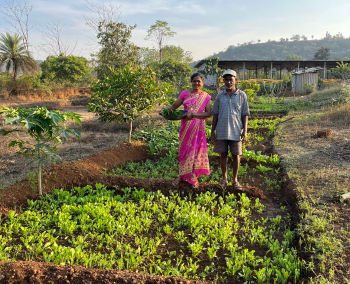
But in the remote villages of rural India, the ones Project Chirag works in, there is no choice to make. Life is already being lived at a fraction of the carbon cost of an urban Indian household, not because of eco-consciousness, but because of circumstance. And that gap is far wider than most people realise.
The Numbers Behind Off-Grid Living and Environmental Impact
Research across Indian households puts the average per capita carbon footprint of a rural household at roughly 0.56 tonnes of CO₂e per year. For an urban household, that figure rises to 2.33 tonnes, more than four times higher. Across districts, the gap can be even starker, with significant variation in per capita emissions within the same country.
What drives that gap? Electricity consumption is one of the largest contributors to household carbon footprints in India, especially in urban areas. Rural households that are off-grid or use minimal electricity, which describes a significant portion of the communities Project Chirag serves, sidestep this entirely. Add to that near-zero private vehicle use, no disposable packaging culture, and diets built around local grains rather than processed or imported goods, and you get a sustainable rural lifestyle in India that the average city dweller would struggle to replicate even with deliberate effort.
Community-Led Environment Protection Has Always Existed Here
The concept of community-led environment protection is often framed as something new, a model to be designed and implemented. In rural India, it is simply how things have worked for generations.
Water is managed collectively. Firewood is gathered with an awareness of what the land can sustain. Agricultural cycles follow seasonal rhythms rather than industrial schedules. Waste, in the urban sense of the word, barely exists. Organic material goes back into the soil, and very little else is purchased in the first place.
None of this is framed as environmentalism. It is just life. But measured against any standard metric of rural environmental sustainability in India, these communities perform exceptionally well.
The People Least Responsible Are Paying the Highest Price
Here is where the picture turns deeply unfair.
The communities contributing least to climate change are facing some of its sharpest consequences. India is already one of the most water-stressed countries in the world, with approximately 600 million people facing high to extreme water stress. Nearly 89% of the groundwater extracted in India goes to irrigation, and government data shows that at least a third of groundwater reserves are being depleted faster than rainfall can recharge them.
In 2016, consecutive weak monsoon seasons pushed millions of Indians into acute water scarcity, causing farm production to fall sharply across states. Erratic rainfall is not an anomaly anymore, it is a pattern. Tribal and rural communities in central India that depend entirely on rain-fed agriculture are recording crop failures in years with below-average precipitation. Studies across central India found direct links between rainfall deficits and increased vulnerability among farming households, with water scarcity reducing agricultural productivity year on year.
The World Resources Institute projects that by 2050, 40% more rain-fed crops will face unreliable water supplies compared to 2020, with India among the most severely affected countries. The people most exposed to this are the ones who have contributed the least to causing it.
Solar Energy for Environmental Protection - and Dignity
When Project Chirag installs solar lighting in a village, the immediate benefit is obvious: children can study after dark, women don’t have to walk to water sources at 2 AM, and families stop using kerosene lamps that produce both toxic fumes and carbon emissions.
But there is a longer arc here that connects directly to rural India green energy outcomes. Kerosene combustion is a significant source of black carbon: a short-lived climate pollutant that contributes meaningfully to atmospheric warming. Replacing kerosene with solar eliminates that source entirely. Solar-powered water systems reduce the distance communities travel for water, cutting both time and the physical cost borne almost entirely by women and girls.
This is solar energy for environmental protection in the most direct sense, not as a talking point, but as a lived outcome in places where the alternative was an open flame.
Everyday Earth Day Actions in Rural India Don't Need a Hashtag
The communities Project Chirag serves don’t observe Earth Day. They live it, every day, in ways that most urban dwellers adopt only in gesture.
No single-use plastics in the weekly market. No air conditioning running through the night. No food was ordered and delivered in layered packaging. No car idling in traffic. These are not choices made after reading an article about sustainability. They are the texture of daily life.
The irony of Earth Day is that its loudest participants are often those with the largest footprints, while its most consistent practitioners are those who have never heard of it.
What This Asks of the Rest of Us
Recognising rural India’s role in everyday environmental sustainability is not about sentimentality. It is about accuracy, about seeing who is actually carrying the environmental load, and who is causing the damage they are forced to absorb.
Project Chirag’s work sits at this intersection. Bringing solar energy, clean water, and education to remote villages doesn’t just improve lives. It does so without adding to the carbon burden these communities have never been responsible for. It is a development on the right side of the climate ledger.
This Earth Day, if you believe the people least responsible for climate change deserve support, not just recognition, you can act on that belief.
Donate To Support Rural Communities
Every village electrified with solar is one more community that gets the light it was always owed, without the cost it never caused.
Sources
- https://medwinpublisher.org/index.php/JENR/article/view/3808
- https://www.worldbank.org/en/country/india/brief/how-india-is-addressing-its-water-needs
- https://scienceinsights.org/the-growing-crisis-of-water-scarcity-in-india/
- https://www.drishtiias.com/daily-news-editorials/india-s-neglected-groundwater-crisis
- https://pmc.ncbi.nlm.nih.gov/articles/PMC7904249/
- https://www.worldbank.org/en/country/india/brief/how-india-is-addressing-its-water-needs