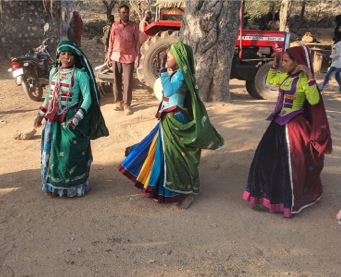
The headlines often tell us a one-dimensional story of “progress” for those in the city. A new mega-dam that will bring electricity to millions of people, and an industrial corridor that will stimulate the economy. These are presented as symbols of a nation on the move. The photographs shine bright, and Twitter announcements boast about their lofty announcements.  

But the rest of this story is often left implicitly behind the headlines. We are left with another story. The story of a quiet Adivasi village, a community that has walked with the forest for generations, whose ancestral territory now lies in the footsteps of this “progress.” The story they are left with is not one of progress; it is one of loss, a substantial loss, the displacement of Indigenous people from their space, their culture, their history. 

This is not a unique or rare story; it is a painful, repetitive pattern. While Adivasi communities comprise just 8.6% of the total Indian population, they have accounted for more than 40% of all people displaced from their homes due to development since independence. It is one thing to be displaced, but always by the recent history of colonialism, where an entire way of life is removed. 

What if these stories could tell a new collective tale? It is time to change the narrative and create a more empathetic, sustainable way forward.

Strengthening Roots: Rethinking Development in India

Imagine a different kind of development. One that doesn’t arrive with eviction notices, but with tools that strengthen a community from within. This is the heart of development without displacement. It’s a vision built not on extraction, but on empowerment.

This model follows a few simple, yet powerful ideas:

  • It’s community-led: Solutions are created with people, respecting their wisdom and agency.
  • It’s sustainable: It works in harmony with the local environment.
  • It’s empowering: It builds local skills, fosters self-reliance, and upholds dignity.

This isn’t just a hopeful theory. It’s a reality unfolding in villages across the country. It’s a story we at Project Chirag are humbled to be a part of, one community at a time.

More Than Light: The Social Impact on Tribal Communities

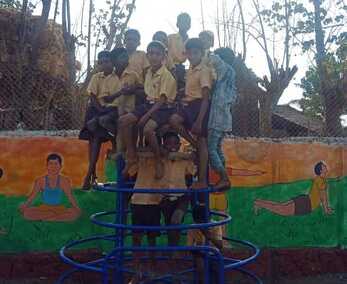
Meet Mahindra Harad, a primary school teacher in Bartadpada, a rural community in Palghar, Maharashtra. For years, his passion for teaching was met with the harsh realities of energy poverty.

“Our journey wasn’t always smooth,” Mahindra ji shares. “Absenteeism was at its peak during the monsoon and summer months. We frequently experience power outages, resulting in darkness… the lack of electricity forced us to keep windows and doors open for light, allowing rainwater to enter the classrooms, leading to wet floors and making it impossible for children to attend classes.”

The summers were just as unforgiving. “The classrooms became unbearably hot,” he recalls, “causing some children to faint due to the heat.”

This is the kind of daily struggle that can dim even the brightest of aspirations. But then, a change came. Not by displacing the village, but by empowering it through a solar electrification project.

“Solar power made this positive change possible,” he says with a smile. “Our classrooms were well-lit and equipped with television, significantly boosting children’s engagement levels and interest in learning. The increase in attendance and interest of children to learn has made me even more enthusiastic and energized to teach more efficiently.”

This is the incredible social impact of rural development in India when it’s done right. A simple solar panel doesn’t just light up a room; it lights up a child’s future. It keeps a teacher inspired. It makes a village safer and more productive, giving people a powerful reason to stay and thrive right where their roots are.

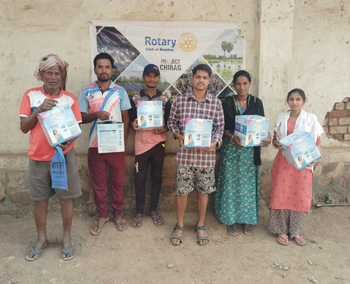
This story perfectly captures the journey of Project Chirag. We began in 2010 as a youth-powered initiative and evolved into an organization focused on an Integrated Village Development Model, using the multidimensional power of solar energy to holistically uplift communities.

The Path Forward: Upholding Tribal Rights and Development

The positive change in communities like Bartadpada shows us that a more just and humane path is possible. But making this the norm, not the exception, is a collective responsibility.

It requires us to champion policies that secure tribal rights and development, like the Forest Rights Act, ensuring communities have a say over their ancestral lands. It calls on corporations to invest in CSR that truly empowers, and on each of us as individuals to support organizations that work on the ground, hand-in-hand with communities.

True progress isn’t measured by the height of our dams, but by the strength of our communities. It’s not about what we build on top of the land, but about the well-being of the people who call it home.

It’s time to choose development that doesn’t cast a shadow of displacement, but instead, brings the empowering glow of light.

You can be a part of this change.

  • Empower a Village: Your contribution can help us bring sustainable light to another community like Bartadpada, ensuring children can study and families can thrive. Donate to solar power NGO.
  • Share this Story: Help us change the conversation around development in India. Share this article with your friends and family.

Follow Our Journey: See the real-time impact of our work by following us on Instagram and Facebook.

Stories of change