How Rural Women Bear the Burden of Resource Scarcity. And How Solar Changes That
Every year on March 8, the world pauses to celebrate women. But for millions of women in rural India, there is no pause. Before sunrise, they are already on their feet. Walking kilometres to fetch water, gathering firewood in the dark, cooking over smoke-filled chulhas, and managing households without so much as a reliable light bulb.
This is not a story of resilience alone. It is a story of a system that has, for decades, placed the weight of resource scarcity squarely on women’s shoulders.
The Hidden Cost of No Electricity and No Clean Water for Women in Rural India
When we talk about women’s resource scarcity in India, we often reach for statistics. But the numbers only tell part of the story.
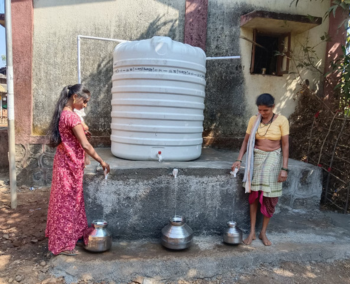
In Tokpada village in Nashik’s Adgaon region, women made a minimum of two to three trips daily to the nearest water source. 2.5 kilometres away, on a treacherous, unlit path, often barefoot. Each trip took close to two and a half hours, balancing three heavy pots on the return. That is five to seven hours. Every single day. Just for water.
Chandrabagha Jadhav, a villager and mother, put it plainly:
“Because of the loss of time, we don’t get to feed our children before school, so they end up skipping classes that day, as they cannot attend on an empty stomach. The main advantage is that our bodies won’t hurt and pain anymore.”
Another woman added, “We commence our trips by 5 am, and almost our entire day revolves around the task of fetching water. There is no time left for any productive activities; we cannot help out at the farm either.”
This is what women’s livelihood in rural India actually looks like when the basics are absent. It is not poverty of ambition. It is a poverty of infrastructure.
Why Women Pay the Highest Price
The burden of resource collection: water, fuel, fodder falls overwhelmingly on women and girls in rural households. This is not incidental. It is a direct consequence of how domestic labour is divided, and how long women’s resource scarcity in India has gone unaddressed as a development priority.
Here is what no electricity and no clean water cost rural women in India every day:
- Time: Hours lost to water collection and firewood gathering, stolen from income-earning work, rest, and education
- Health: Chronic back and joint pain from carrying heavy loads; respiratory illness from years of cooking over biomass fuel indoors
- Safety: Walking alone in the dark to reach water, or for open defecation, because there are no toilets and no street lights
- Education: Girls were pulled out of school to help with water duties; boys were used as water carriers instead of attending class
- Economic independence: No light after dark means no evening study, no home-based business, no livelihood beyond daylight hours
This is the real barrier to rural women’s empowerment in India. Not a lack of will, but a deliberate lack of infrastructure.
What Solar Power Actually Does for Women
Solar energy in rural India is often framed as an environmental solution. But in practice, clean energy for rural women is a social and economic intervention first.
When a home gets a solar light:
- Children study after dark
- Women work in the evenings: stitching, weaving, sorting produce
- Streets become safer; women no longer venture out in the dark for sanitation
- Kerosene costs drop in Project Chirag villages, families save close to ₹100 per litre previously spent on kerosene lamps
- Toxic smoke from kerosene disappears from living spaces entirely
When solar power in rural communities is paired with solar-powered water systems, the change goes deeper. Women get back hours of their day. They go to the farm. Their children reach school on a full stomach. Their bodies stop carrying the toll of years.
In Tokpada, after Project Chirag installed an ultrafiltration water plant powered by solar lift irrigation, the village ASHA worker noted that their stock of 50 tablets for cough, fever, and dysentery, which used to last two months, lasted eight months once clean water arrived. A number that says everything without needing explanation.
That is what sustainable solutions in rural India look like on the ground.
Project Chirag: 15 Years of Lighting the Forgotten Bharat
Project Chirag has been working since 2010 to bring solar energy to rural India, reaching villages that are largely invisible to urban India and national policy conversations. Over 300 million Indians still lack access to light, clean water, sanitation, food security, and livelihood support. Project Chirag works inside that gap: one village, one community at a time.
Pratibha Pai, Founder Director of Project Chirag, describes the communities they work with: “The villagers of Tokpada are iron-willed people. I was amazed to see their level of follow-up and stubbornness as they kept following us wherever we went, for installation programs or impact assessments. This is because they have first-hand witnessed the benefits the village and the villagers have got through our transformation programs in other places.”
What sets Project Chirag apart as an NGO working for rural women in India is that every intervention is designed around a village’s specific needs, not a template dropped from outside. Our work spans:
- Solar home lighting for households, streets, and schools
- Solar-powered water filtration and lift irrigation. Clean drinking water and year-round irrigation for crops, reducing migration
- Anganwadi support. Powering child and maternal care centres
- Sanitation infrastructure. Toilets that give women back their safety and dignity
- Tree plantation for food security and sustainable income
Each of these directly reduces the weight that lands on women when resources are absent.
The Question This Women's Day
What does women’s empowerment mean without electricity?
Without light, there are no evening classes, no after-dark businesses, no safe streets. Without clean water, there is no time, only the endless loop of walking, carrying, and returning to do it again.
Solar energy in rural India is not just a clean energy story. It is a gender equity story. Clean energy for rural women is not an add-on to development. It is development.
This International Women’s Day, the most direct path to rural women’s empowerment in India runs through something as simple and as long-overdue as a light that stays on after dark, and a tap that works.
Support rural development. Or join the movement as a volunteer, youth ambassador, or corporate partner.
Project Chirag is a non-profit enabling solar-powered, self-sufficient rural development across India. Learn more at projectchirag.org.