5 Reasons Rural India Needs Clean Energy Now More Than Ever
Over 300 million Indians, roughly 25% of the population, still lack consistent access to basic necessities like light, clean water, and safe cooking fuel. Many rural families still experience daily energy shortages once the sun sets. Clean energy in rural India is not a development buzzword. It is a matter of survival, dignity, and justice.
This Earth Day, as the world talks about net-zero goals and green transitions, the villages that Project Chirag, a rural development NGO, works with are asking for something far more fundamental: the right to light.
The Grid Reached the Village. Electricity Didn't.
India’s rural electrification story has two very different chapters. On paper, the Saubhagya scheme connected over 95% of households to the grid by 2020. On the ground, connection does not mean electricity.
65% of rural homes cannot afford to meet their electricity needs, even when grid access exists, forcing families to rely on kerosene lamps and open biomass fires. Around 12,000 villages across India still receive fewer than 8 hours of power supply daily.
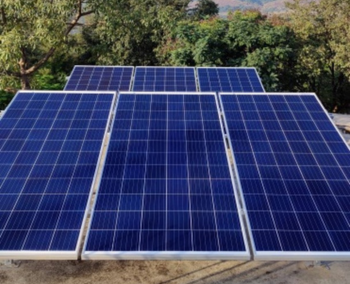
This is precisely why off-grid solar power in India matters so much. Unlike grid electricity, a solar energy system for rural communities, once installed, doesn’t depend on transmission infrastructure, subsidies, or erratic supply schedules. The sun shows up every morning. The light stays on.
Kerosene Is Quietly Killing People
In the absence of reliable light, millions of rural households burn kerosene lamps each night. The WHO estimates that over half a million Indians die prematurely every year from indoor air pollution caused by burning biomass fuels. Kerosene is a significant contributor to that number.
The health toll is not abstract:
- Respiratory diseases are sharply elevated in homes with persistent kerosene use.
- Children study in smoky, dim light, or stop studying altogether after dark.
- Women, who typically manage household energy, face the highest and most prolonged exposure.
Solar lighting for rural households eliminates these risks at their root. Project Chirag’s on-the-ground experience shows a 45% reduction in illness linked to indoor air pollution after solar systems are introduced in a village. Each solar home system also prevents roughly 1.5 tons of CO₂ emissions annually, contributing directly to India’s climate commitments.
No Light After Dark Means No Progress
Energy poverty and human development move in lockstep. A child who can’t read after sunset falls behind at school. A woman who can’t run her small enterprise after dusk loses income. Health workers often struggle to navigate village roads at night after emergency deliveries due to a lack of lighting. That’s a life-threatening gap.
The evidence from sustainable energy solutions in rural India tells a clear story:
- Children gain an average of 2.5 additional study hours per day after solar electrification.
- Households save up to 20% more monthly once kerosene expenditure drops, sometimes as much as ₹500 per month.
- Local shops extend their operating hours, directly boosting economic activity in the village.
- Women-led self-help groups form around renewable energy ventures, creating new livelihoods.
Energy access in rural India is not just about switching on a light. It’s about switching on opportunity.
India's Climate Goals Cannot Ignore 300 Million People
India has made bold commitments. 500 GW of non-fossil fuel capacity by 2030, net zero by 2070. But the energy transition cannot be built on cities and industry alone, then handed down to villages as an afterthought.
Every family that replaces a kerosene lamp with solar light is reducing black carbon emissions, among the most potent short-term climate forcers. Every village that moves away from biomass cooking reduces deforestation pressure on surrounding forests. Renewable energy in Indian villages is not a charity model. It’s a climate strategy.
Project Chirag‘s approach is a model that scales precisely because it doesn’t try to fit rural realities into an urban template, building decentralised solar micro-grids tailored to each village’s specific needs. Trained village energy committees maintain the systems long after the installation team has left.
Earth Day Asks: Who Is the Energy Transition Actually For?
Every April 22, conversations about the planet fill our feeds. Solar panels on rooftops in Bengaluru and Mumbai. EV charging stations. Green bonds. These are real and important, but they are not the whole picture.
The most urgent solar energy for rural communities is not about luxury or efficiency. It’s about a mother in Maharashtra who no longer has to wake her children in the dark to study before dawn. It’s about a girl in Jharkhand who now passes her exams because she can read at night. It’s about an anganwadi worker who can refrigerate vaccines in a remote village.
Project Chirag has been working since 2010 to ensure that energy access in rural India reaches these exact families. Not just the ones close to a grid, not just the ones who can afford a refill. One village at a time, one solar lamp at a time.
What You Can Do This Earth Day
A donation for rural development provides a household with uninterrupted solar power for five or more years. A donation of any size funds solar street lights, community electrification, and water access for villages that the grid has still not reached.
This Earth Day, don’t just go green. Bring someone into the light.
Share this blog | Join the #GoSolar movement